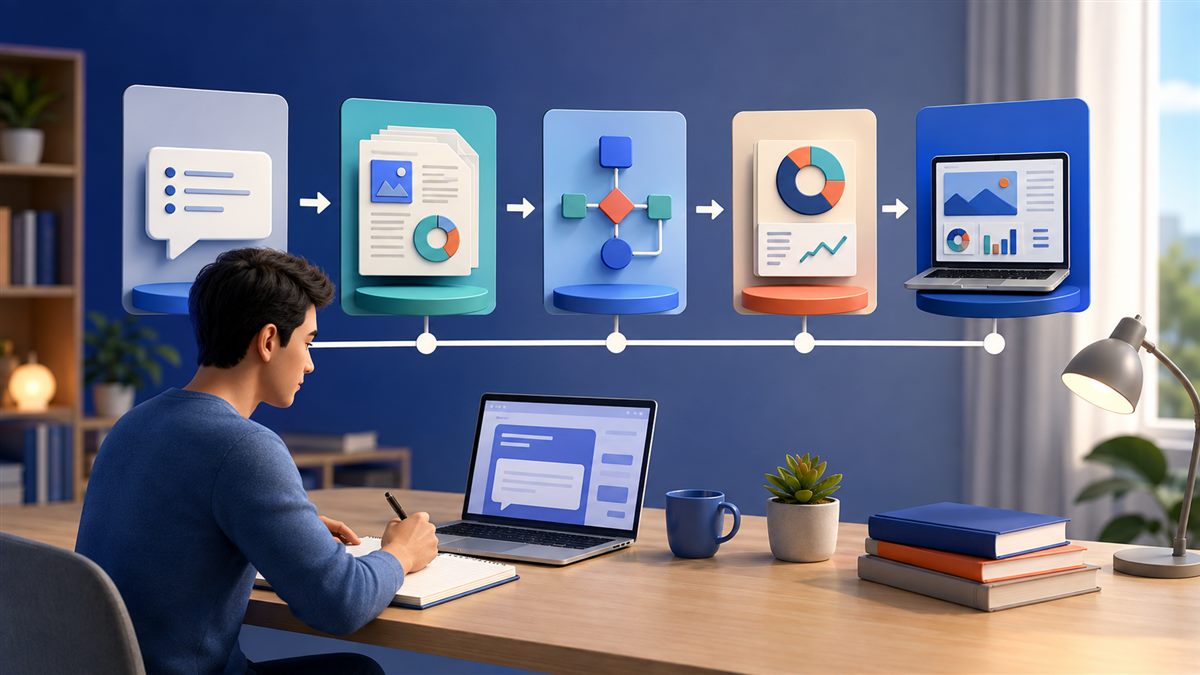
This plan is for learners who understand ideas best by making something small. It avoids tool rankings and focuses on a project loop that can be repeated with different topics. Use sample data and treat each result as a hypothesis to inspect, not as proof of general model quality.
Step 1: Pick a narrow question
Choose a task with a visible result, such as sorting fictional comments into themes, classifying permitted images, or asking a model to extract dates from a public notice. Avoid high-impact tasks and sensitive inputs.
Step 2: Define a human reference
Before asking a model, decide what a correct or acceptable output would look like. Write down normal examples and at least one ambiguous case. If you cannot tell whether an answer is right, narrow the task or find an authoritative source.
Step 3: Follow one official learning exercise
Use a current lesson from Google’s Machine Learning Crash Course or an exercise in the Kaggle Learn catalog, after confirming prerequisites and account requirements. The goal is to understand the technique, not to collect courses or copy code without explanation.
Step 4: Change one thing at a time
Keep the task and evaluation examples stable while changing one prompt, input feature, or setting. Record what changed and whether the result moved closer to your reference. A small sample cannot support broad accuracy estimates.
Step 5: Write a short project note
- Purpose and intended user.
- Tool, version, date, and setup needed to reproduce.
- Allowed input and expected output.
- Observed failure and a human-review rule.
- Privacy, cost, and limitations.
Step 6: Decide whether to continue
Continue only if you can explain what the model did, where it failed, and what additional evidence would be needed. For work or production use, check permissions, representative data, monitoring, fallback, and human accountability with the responsible team.
Use a project brief before you open a notebook
Small projects become easier to compare when the learner decides what “finished” means first. Copy this brief into a note: question; intended user; permitted input; output a person can inspect; human reference; likely failure; privacy boundary; and the next decision if the result is wrong. If you cannot write a reference answer, narrow the project until correctness can be judged.
Keep a change log for the learning loop
For each attempt, change one prompt, data example, feature, or setting at a time. Record the change and inspect the same examples again. Keep ambiguous and out-of-scope cases in the review set rather than removing them because they are inconvenient. This helps you notice when an apparent improvement on familiar examples comes with a new failure elsewhere; it is not a statistical performance estimate.
End a project with a short handoff note: what the model was asked to do, what it cannot establish, what sources or sample data were used, and what a human must verify. A project is ready to share as a learning artifact when another person can reproduce its setup and understand its limitations. Production work needs additional controls, evaluation data, monitoring, and an accountable owner.
This article focuses on a reusable project loop. For a set of fictional input/output demonstrations, see the sample-data examples; for a staged path with three build briefs, use the project progression.
Related reading
For a broader set of synthetic exercises, see the sample-data practice exercises. For a continuous free resource progression, read the free AI learning path.
About the author
Femica Maydinda Harend writes practical technology guides for AILooma, prioritizing repeatable learning and honest limitations.
Editorial note
This plan is instructional and does not claim classroom testing, learner outcomes, or measured retention. Course details and tools may change.