Tag: google sheets api

  • Google Sheets to Notion Automation with n8n: A Practical Guide

    Google Sheets to Notion Automation with n8n: A Practical Guide

    Google Sheets and Notion are both useful for organizing structured information, but they often end up containing the same data in different places.

    A marketing team may track campaign metrics in Google Sheets while keeping project documentation in Notion. A support team may collect requests in a spreadsheet but manage follow-up work in a Notion database.

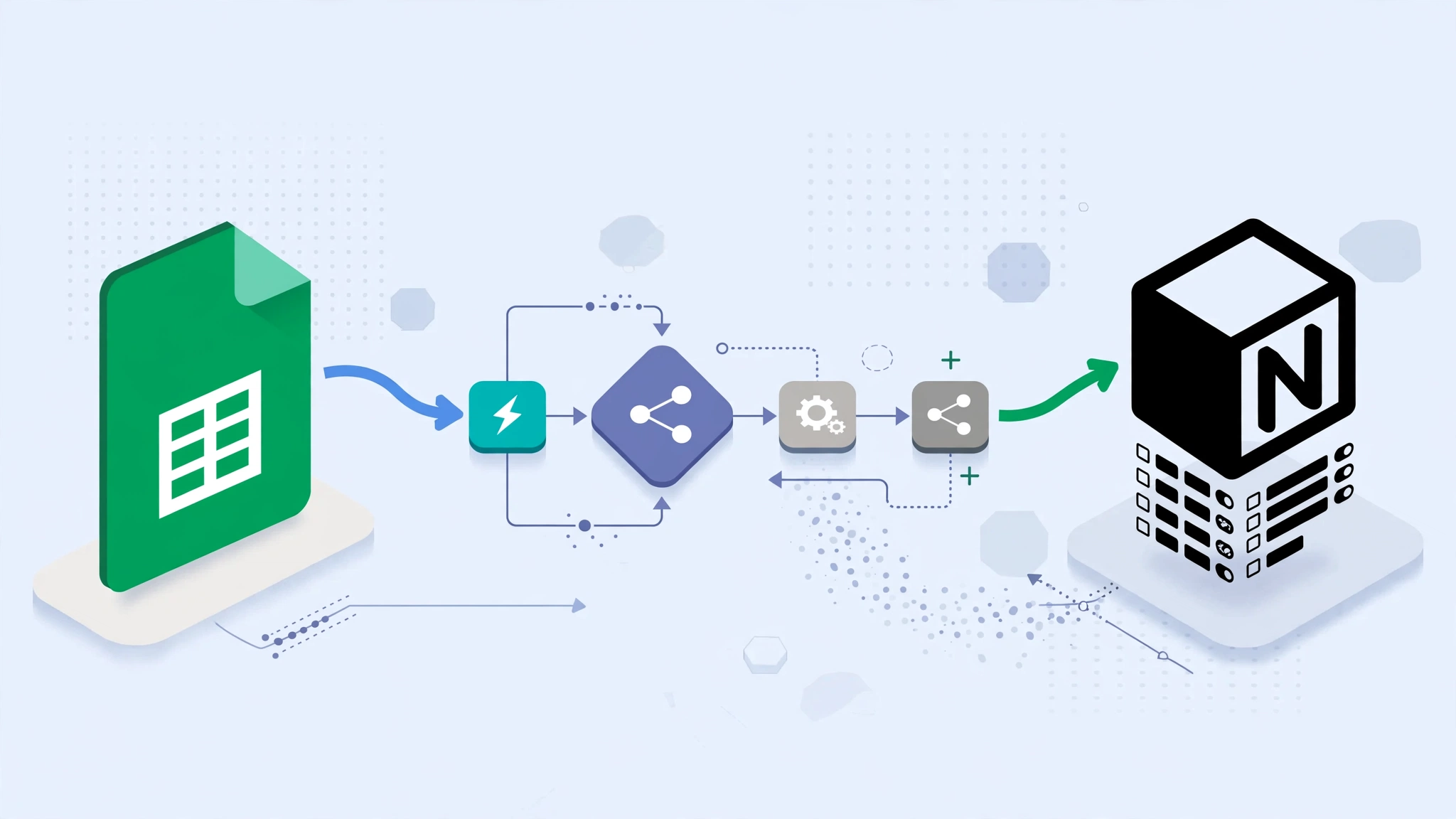
    Instead of copying information manually, you can use n8n to sync Google Sheets with Notion.

    This guide explains a practical one-way synchronization workflow, how to prevent duplicate Notion records, how to handle updates safely, and what to consider before attempting a more complicated two-way sync.

    What Are We Building?

    The basic workflow is:

    Google Sheets
          ↓
    n8n
          ↓
    Validate and Transform
          ↓
    Find Existing Notion Record
          ↓
    Create or Update
          ↓
    Log Result

    Google Sheets remains the source of the incoming structured data, while Notion becomes the destination used for dashboards, project tracking, or team workflows.

    Why Use n8n Between Google Sheets and Notion?

    You could write your own script using the Google Sheets and Notion APIs.

    n8n is useful because it provides a visual layer for:

    • authentication;
    • scheduled execution;
    • data transformation;
    • conditional branching;
    • API calls;
    • error handling;
    • execution history.

    This makes the workflow easier to inspect than a collection of disconnected scripts.

    It does not automatically make the workflow reliable, secure, or compliant. Those qualities still depend on how you design and operate it.

    Example Use Case

    For this tutorial, imagine a Google Sheet containing support tickets.

    The columns are:

    ID
    Subject
    Description
    Status
    Assignee
    Created Date
    Priority

    We want each row to create or update a corresponding record in a Notion database.

    The important field will be ID.

    That ID acts as our stable identifier so the workflow can determine whether a row already exists in Notion.

    Before You Start

    You will need:

    • a Google account with access to the spreadsheet;
    • a Notion workspace;
    • a Notion database or data source for the synchronized records;
    • an n8n instance;
    • credentials for Google Sheets and Notion configured in n8n.

    The exact authentication screens and node options can change between n8n and API releases, so use the current n8n documentation when connecting the accounts.

    Step 1: Prepare the Google Sheet

    Create a spreadsheet with predictable column names.

    For example:

    ID Subject Description Status Assignee Created Date Priority
    TKT-001 Login problem User cannot sign in Open alex@example.com 2026-09-01 High

    Use a Stable ID

    This is one of the most important parts of the workflow.

    Do not use the row number as the permanent identity of the record.

    Rows can move when someone sorts or inserts data.

    Instead, create a unique ID such as:

    TKT-001
    TKT-002
    TKT-003

    That ID should not change during the lifetime of the record.

    Step 2: Prepare the Notion Database

    Create a Notion database with corresponding properties.

    For example:

    • Subject — Title
    • ID — Text
    • Description — Text
    • Status — Select or Status
    • Assignee — Text or another appropriate property
    • Created Date — Date
    • Priority — Select
    • Last Synced — Date

    The property types need to match the values the workflow sends.

    For example, sending arbitrary text into a Notion date property will fail if it cannot be interpreted correctly.

    Step 3: Connect Google Sheets to n8n

    In n8n, create Google Sheets credentials using the authentication method supported by your environment.

    Then add a Google Sheets node and select:

    • the Google account;
    • the spreadsheet;
    • the relevant sheet or tab;
    • the operation that reads rows.

    Run the node once and inspect its output.

    Do not continue building the workflow until the returned fields match what you expect.

    Step 4: Connect Notion to n8n

    Create a Notion integration and give it access only to the pages or databases required by this workflow.

    Then create the Notion credential inside n8n.

    A useful security rule is:

    Do not give an automation access to more Notion content than it actually needs.

    If the workflow only updates one support database, there is usually no reason to expose unrelated workspace content to the integration.

    Step 5: Add a Trigger

    For the simplest version, use a schedule.

    For example:

    Schedule Trigger
          ↓
    Google Sheets

    You might run it periodically depending on how fresh the data needs to be.

    There is no universal requirement to run every minute or every five minutes.

    Higher frequency creates more API traffic and more opportunities for overlapping executions.

    Step 6: Read the Sheet Rows

    Add the Google Sheets node after the trigger.

    The output should produce one n8n item for each row you want to process.

    For example:

    {
      "ID": "TKT-001",
      "Subject": "Login problem",
      "Description": "User cannot sign in",
      "Status": "Open",
      "Assignee": "alex@example.com",
      "Created Date": "2026-09-01",
      "Priority": "High"
    }

    Inspect this data carefully before transforming it.

    Step 7: Normalize the Data

    Spreadsheet data is often inconsistent.

    Typical problems include:

    • extra spaces;
    • empty cells;
    • different capitalization;
    • invalid dates;
    • unexpected status values.

    A Code node can normalize values.

    For example:

    return $input.all().map(item => {
      const row = item.json;
    
      return {
        json: {
          id: String(row.ID || '').trim(),
          subject: String(row.Subject || '').trim(),
          description: String(row.Description || '').trim(),
          status: String(row.Status || '').trim(),
          assignee: String(row.Assignee || '').trim(),
          createdDate: row['Created Date'] || null,
          priority: String(row.Priority || '').trim(),
          syncedAt: new Date().toISOString()
        }
      };
    });

    The exact transformation depends on the data returned by your Google Sheets node.

    Step 8: Reject Rows Without an ID

    A missing ID makes reliable synchronization difficult.

    Add an IF node after normalization.

    Continue only when:

    id is not empty

    Rows without an ID can be sent to an error or review branch instead of silently creating duplicate Notion records.

    Step 9: Look for an Existing Record in Notion

    Before creating a new record, search Notion using the stable ID.

    The logic becomes:

    Google Sheet Row
          ↓
    Search Notion by ID
          ↓
    Found?
     ↙          ↘
    Yes          No
     ↓            ↓
    Update       Create

    This is the basic upsert pattern.

    Why Search by ID Instead of Subject?

    Subjects are not reliable identifiers.

    Two tickets could both be called:

    Login problem

    A dedicated ID avoids that ambiguity.

    Step 10: Create the Record if It Does Not Exist

    If the Notion lookup returns no matching record, create one.

    Map the normalized values to their corresponding Notion properties.

    For example:

    • Subject → subject
    • ID → id
    • Description → description
    • Status → status
    • Priority → priority
    • Last Synced → syncedAt

    Step 11: Update the Record if It Already Exists

    If the ID already exists, update the existing Notion record instead of creating another one.

    This is what makes the workflow idempotent at the business-record level.

    Running the workflow twice should not create two records for the same TKT-001.

    Step 12: Be Explicit About Which System Owns Each Field

    This becomes important when people also edit Notion manually.

    For example, suppose:

    • Google Sheets owns Subject and Priority;
    • Notion owns Internal Notes;
    • Google Sheets owns Status.

    Then the n8n workflow should update only the fields owned by Sheets.

    Do not overwrite every Notion property on every run.

    This prevents automation from deleting legitimate manual work.

    Step 13: Add a Last Synced Timestamp

    A Last Synced property makes troubleshooting much easier.

    Set:

    new Date().toISOString()

    whenever n8n successfully creates or updates the record.

    This gives the team a visible indication that the workflow touched the record.

    Step 14: Do Not Assume Every Blank Cell Means “Delete”

    Suppose the Assignee column in Google Sheets is empty.

    There are at least two possible interpretations:

    • remove the existing Notion assignee;
    • leave the existing Notion assignee unchanged.

    Those are very different operations.

    Define the behavior explicitly instead of letting empty values silently overwrite data.

    Step 15: Validate Status and Select Values

    Notion properties such as Status and Select often expect known values.

    If Google Sheets contains:

    open
    Open
    OPEN
    Open 

    your workflow may need to normalize them first.

    For example:

    const statusMap = {
      "open": "Open",
      "in progress": "In Progress",
      "resolved": "Resolved"
    };
    
    const normalizedStatus =
      statusMap[String(row.Status || '').trim().toLowerCase()] || "Open";

    This gives the transformation logic a predictable output.

    Step 16: Handle Dates Carefully

    Dates are another common source of errors.

    Google Sheets can return dates differently depending on configuration and how the value is read.

    Do not assume every Sheets date is automatically a Unix timestamp.

    Inspect the actual value first.

    Then convert it deliberately into an ISO 8601 date that Notion accepts.

    Step 17: Add Error Handling

    A production workflow should not simply stop without visibility when one item fails.

    Common errors include:

    • Google authentication failure;
    • Notion authentication failure;
    • invalid property type;
    • missing required field;
    • API rate limiting;
    • temporary network failure;
    • deleted or inaccessible Notion destination.

    Use n8n’s current error-handling features to route failures into a dedicated workflow or notification path.

    Keep the failure information useful:

    • record ID;
    • workflow name;
    • failed step;
    • error message;
    • execution timestamp.

    Step 18: Do Not Log Sensitive Payloads Unnecessarily

    Execution logs can become a secondary copy of your business data.

    If the Sheet contains:

    • customer information;
    • employee data;
    • private support conversations;
    • financial information;

    review what n8n stores in execution history.

    Logging everything indefinitely can create a privacy and security problem of its own.

    Step 19: Respect Google Sheets API Limits

    The Google Sheets API has usage quotas.

    Current Google documentation recommends combining multiple reads or writes where practical because batch operations improve efficiency. :contentReference[oaicite:1]{index=1}

    Do not design the workflow around outdated hard-coded quota numbers copied from old tutorials.

    If Google returns a rate-limit response, apply retries with backoff rather than immediately repeating requests in a tight loop.

    Step 20: Respect Notion API Rate Limits Too

    Notion also applies rate limits.

    Do not assume a fixed request-per-second number will remain unchanged forever.

    Use the API’s returned status and retry guidance where available, and avoid making unnecessary requests.

    Reduce Repeated Lookups

    If every row requires:

    1. one Notion search;
    2. one update;

    then 1,000 rows can generate a large number of API calls.

    At larger scale, consider maintaining a mapping of:

    Source ID → Notion Page ID

    in a reliable store.

    Do not cache IDs blindly forever, but there is also no reason to claim that Notion page IDs routinely change whenever pages move. The workflow should simply handle missing or inaccessible pages gracefully.

    Step 21: Batch Carefully

    Batching does not necessarily mean Notion provides a native “create 100 pages in one request” operation.

    Instead, batching in n8n often means controlling how many items the workflow processes at a time.

    For example:

    1000 rows
       ↓
    Process 20
       ↓
    Wait / Continue
       ↓
    Process Next 20

    This helps control memory use and API pressure.

    Step 22: Avoid Overcomplicating the First Version

    The first production-worthy workflow does not need:

    • Redis;
    • multiple n8n workers;
    • a load balancer;
    • Prometheus;
    • Grafana;
    • custom CI/CD;
    • two-way synchronization.

    Start with:

    Schedule
      ↓
    Read Rows
      ↓
    Normalize
      ↓
    Find by ID
      ↓
    Create or Update
      ↓
    Error Handling

    Only add infrastructure when the workflow actually needs it.

    Two-Way Sync Is Much Harder

    It is tempting to say:

    “If Sheets changes, update Notion. If Notion changes, update Sheets.”

    But two-way synchronization creates several new problems.

    Conflict Example

    At 10:00:

    Sheets Status = Open

    At 10:01, someone changes Notion to:

    Status = Resolved

    At 10:02, someone changes Sheets to:

    Status = Escalated

    Which value should win?

    Without explicit ownership or conflict-resolution rules, the systems can continuously overwrite each other.

    A Safer Two-Way Sync Design

    If two-way synchronization is genuinely necessary, define:

    • which system owns each property;
    • how changes are timestamped;
    • how the source of a change is recorded;
    • how loops are prevented;
    • what happens when both sides change;
    • how conflicts are surfaced to humans.

    Example Ownership Model

    Field System of Record
    ID Google Sheets
    Subject Google Sheets
    Priority Google Sheets
    Internal Notes Notion
    Review Status Notion

    This is usually easier to reason about than letting both systems edit everything.

    When a Webhook Makes Sense

    A schedule is often simpler.

    Webhooks become useful when:

    • changes need to propagate quickly;
    • the source platform exposes a suitable event mechanism;
    • you can verify incoming requests;
    • the workflow can safely handle duplicate events.

    Do not add webhook infrastructure only because “real-time” sounds better.

    Security Considerations

    A Sheets-to-Notion workflow may move business information between multiple systems.

    Review:

    • who can access the Google Sheet;
    • which Notion pages the integration can access;
    • who can modify the n8n workflow;
    • where n8n credentials are stored;
    • how much execution data is retained;
    • whether the n8n instance is exposed to the public internet;
    • which fields contain personal or confidential information.

    Self-Hosting Does Not Automatically Mean Secure

    Self-hosting can provide more control over infrastructure and credential storage.

    But it also makes you responsible for:

    • patching;
    • TLS configuration;
    • network security;
    • backups;
    • access controls;
    • monitoring;
    • incident response.

    Do not treat self-hosting itself as proof of GDPR, HIPAA, SOC 2, or other compliance.

    How to Make the Workflow Easier to Maintain

    Use descriptive node names.

    For example:

    Read Support Tickets
    Normalize Ticket Fields
    Validate Ticket ID
    Find Ticket in Notion
    Create New Ticket
    Update Existing Ticket
    Record Sync Failure

    This is easier to maintain than nodes named:

    Google Sheets1
    Code3
    IF2
    Notion4

    Document Important Decisions

    Add notes explaining:

    • which system owns each field;
    • why a field is transformed;
    • how duplicate detection works;
    • what happens when an API is unavailable;
    • who maintains the workflow.

    A Practical Testing Checklist

    Before activating the workflow, test:

    • a normal new row;
    • an existing row that needs updating;
    • a row without an ID;
    • an empty optional field;
    • an invalid status value;
    • an invalid date;
    • a temporarily unavailable Notion destination;
    • duplicate execution of the same source row.

    The last test is especially important.

    Running the same input twice should not create duplicate business records.

    When Google Sheets Is the Wrong Source

    Google Sheets works well for relatively simple collaborative datasets.

    It becomes less attractive when:

    • the dataset is extremely large;
    • many systems write simultaneously;
    • strict transactional guarantees are required;
    • complex relational data is involved;
    • high-frequency synchronization is required.

    At that point, a database may be a better system of record.

    When Notion Is the Wrong Destination

    Notion works well for team-visible records and knowledge workflows.

    It may not be the best destination for:

    • high-volume telemetry;
    • raw event streams;
    • large analytical datasets;
    • systems requiring strict transactions;
    • machine-to-machine workloads with very high write rates.

    Automation should fit the tools rather than forcing the tools into workloads they were not designed to handle.

    How This Guide Was Prepared

    This guide focuses on a practical synchronization pattern rather than a claim that there is one official architecture for connecting Google Sheets, Notion, and n8n.

    The workflow uses observable concepts that remain useful even when individual node interfaces change:

    • a stable source identifier;
    • data normalization;
    • lookup before create;
    • controlled updates;
    • field ownership;
    • error handling;
    • human-readable execution history.

    n8n nodes, Google APIs, Notion APIs, authentication methods, quotas, and property models can change over time. Verify current official documentation before deploying the workflow.

    The examples here are architectural patterns. They are not claims that named companies or organizations use these exact workflows.

    Frequently Asked Questions

    Can n8n automatically sync Google Sheets with Notion?

    Yes.

    n8n can read data from Google Sheets and use it to create or update records in Notion.

    The reliability of the sync depends on how you handle identifiers, duplicates, field mapping, errors, and conflicts.

    Do I need to code?

    Not for a basic workflow.

    Many transformations can be built with n8n’s visual nodes and expressions.

    JavaScript becomes useful when your mapping or validation logic becomes more complex.

    Can I sync changes both ways?

    Yes, but two-way sync is substantially more complicated than one-way synchronization.

    You need rules for ownership, conflict resolution, update loops, and timestamps.

    Start with one-way sync unless you genuinely need both directions.

    How do I prevent duplicate Notion records?

    Use a stable unique identifier from the source system.

    Before creating a Notion record, search for that ID.

    If it exists, update it. If it does not, create it.

    Can I use the row number as the unique ID?

    It is usually a poor choice.

    Rows can change position when users sort, insert, or delete data.

    A dedicated ID column is more reliable.

    Should I use Google Sheets as the system of record?

    It can work for smaller collaborative workflows.

    For more complex, transactional, or high-volume systems, a database may be a better source of truth.

    Does self-hosted n8n make the sync private?

    Not automatically.

    Google Sheets and Notion remain external services, so data sent to those platforms still leaves the n8n host.

    Self-hosting mainly gives you more control over the orchestration layer.

    Final Takeaway

    A reliable Google Sheets-to-Notion workflow does not need to be complicated.

    The most important pieces are:

    1. use a stable record ID;
    2. normalize the incoming data;
    3. validate required fields;
    4. search before creating;
    5. update only the fields your source owns;
    6. keep errors visible;
    7. avoid unnecessary two-way synchronization.

    Start with a simple one-way sync and test it against duplicate runs, bad data, and temporary API failures.

    Only add webhooks, two-way updates, batching infrastructure, Redis, or distributed n8n workers when the workflow has a real need for them.

  • Windows 11 Backup Monitoring with PowerShell and Google Sheets API

    Windows 11 Backup Monitoring with PowerShell and Google Sheets API

    A backup is only useful if you know whether it actually ran.

    Windows can copy files to another drive, a NAS, or cloud storage, but it is also useful to keep a simple record of each backup: when it ran, which files were processed, whether verification succeeded, and whether anything failed.

    Google Sheets can work well as that backup log.

    It should not be treated as the place where you store your actual backup files. Instead, PowerShell can perform or inspect your backup process and then send status information to a Google Sheet through the Google Sheets API.

    This guide shows how to build a simple Windows 11 backup monitoring workflow with PowerShell and Google Sheets.

    First: Google Sheets Is Not the Backup Destination

    This distinction is important.

    A real backup should create an independent copy of your important files.

    That copy might live on:

    • an external HDD or SSD;
    • a NAS;
    • another computer;
    • approved cloud storage;
    • a dedicated backup service.

    Google Sheets can then record information about that process.

    Example Architecture

    Important Files
          ↓
    Backup Script / Backup Tool
          ↓
    External Drive / NAS / Cloud Storage
          ↓
    Verification
          ↓
    Google Sheets Backup Log

    This gives you two different things:

    • backup storage: where the recoverable copy exists;
    • backup monitoring: where status and verification information is recorded.

    What Should the Google Sheet Record?

    A useful backup log can contain fields such as:

    • timestamp;
    • computer name;
    • source path;
    • destination path;
    • file size;
    • SHA-256 hash where useful;
    • backup status;
    • verification status;
    • error message;
    • duration.

    This makes the Sheet a lightweight monitoring dashboard instead of pretending that spreadsheet rows are the backup itself.

    What You Need

    A basic setup requires:

    • Windows 11;
    • PowerShell;
    • a Google account;
    • a Google Cloud project;
    • the Google Sheets API enabled;
    • a spreadsheet for backup logs;
    • a real backup destination.

    WSL2 is not required for this workflow.

    PowerShell alone is enough for file inspection, hashing, scheduled tasks, and REST API requests.

    Do You Need PowerShell 7?

    PowerShell 7 is a good choice for new automation projects, but it is inaccurate to say that Windows PowerShell 5.1 cannot use Invoke-RestMethod or handle JSON.

    Invoke-RestMethod has existed since earlier Windows PowerShell releases and supports REST requests and JSON responses. :contentReference[oaicite:2]{index=2}

    For a new script, using a current supported PowerShell release is still sensible because it receives newer fixes and features.

    Step 1: Create the Google Sheet

    Create a spreadsheet specifically for backup monitoring.

    For example, create a sheet named:

    BackupLog

    Add these columns:

    Timestamp
    Hostname
    SourcePath
    DestinationPath
    FileSizeBytes
    SHA256
    BackupStatus
    VerificationStatus
    DurationMs
    Error

    You can add more columns later if your workflow becomes more sophisticated.

    Step 2: Create a Google Cloud Project

    Open Google Cloud Console and create or select a project.

    Enable:

    Google Sheets API

    You do not need to enable unrelated APIs simply because the workflow uses OAuth.

    Step 3: Create OAuth Credentials

    For a script that acts on behalf of a user, create an OAuth client appropriate for a desktop application.

    Google’s current OAuth documentation supports the loopback IP flow for Windows desktop applications. A desktop application can listen on a local address such as:

    http://127.0.0.1:RANDOM_PORT

    The application then receives the authorization response locally. Google recommends using the system browser for this flow. :contentReference[oaicite:3]{index=3}

    Do not use the old manual copy-and-paste OAuth flow. Google documents that method as deprecated and unsupported. :contentReference[oaicite:4]{index=4}

    Service Account or User OAuth?

    The draft version of this guide said service accounts must never be used. That is too absolute.

    Both approaches can be valid.

    User OAuth

    This is useful when:

    • the Sheet belongs to a specific user;
    • the script should operate using that user’s authorization;
    • interactive authorization is acceptable during initial setup.

    Service Account

    This may be appropriate for controlled server-side or organizational automation where the spreadsheet is explicitly shared with the service account.

    The correct choice depends on ownership, deployment architecture, and access-control requirements.

    Step 4: Use the Minimum OAuth Scope

    If the script only needs to read and write spreadsheet content, the Google Sheets scope is typically sufficient:

    https://www.googleapis.com/auth/spreadsheets

    Avoid requesting broader Google Drive or account scopes unless your workflow actually needs them.

    Step 5: Create a Real Backup Before Logging Anything

    For demonstration purposes, imagine we want to copy:

    C:\Users\YourName\Documents\Research

    to:

    E:\Backups\Research

    You could use an existing backup tool or a Windows utility such as Robocopy.

    For example:

    robocopy "C:\Users\YourName\Documents\Research" "E:\Backups\Research" /E /COPY:DAT /DCOPY:T

    Do not blindly copy this command into an important production workflow.

    Read the current Robocopy documentation and test against disposable files first, especially before adding options that delete or mirror destination content.

    Step 6: Collect Backup Metadata With PowerShell

    After the backup runs, PowerShell can collect information that will later be sent to Google Sheets.

    For a single file:

    $sourcePath = "C:\Users\YourName\Documents\example.txt"
    
    $file = Get-Item $sourcePath
    
    $hash = Get-FileHash `
        -Path $sourcePath `
        -Algorithm SHA256
    
    $row = @(
        (Get-Date).ToUniversalTime().ToString("o"),
        $env:COMPUTERNAME,
        $sourcePath,
        "E:\Backups\example.txt",
        $file.Length,
        $hash.Hash,
        "Success",
        "Pending",
        0,
        ""
    )

    This creates metadata.

    It does not create the backup itself.

    Step 7: Verify the Backup

    Logging Success simply because the copy command finished is not enough for important files.

    You can perform a basic verification by comparing source and destination hashes.

    $sourceHash = (Get-FileHash `
        -Path $sourcePath `
        -Algorithm SHA256).Hash
    
    $destinationHash = (Get-FileHash `
        -Path $destinationPath `
        -Algorithm SHA256).Hash
    
    if ($sourceHash -eq $destinationHash) {
        $verification = "Verified"
    }
    else {
        $verification = "Mismatch"
    }

    A matching hash indicates that the two files contained the same bytes when they were hashed.

    It does not prove that your entire backup strategy is healthy or that the storage device will remain reliable indefinitely.

    Step 8: Append a Row to Google Sheets

    The Google Sheets API supports appending values to the end of an existing table using:

    spreadsheets.values.append

    The request body contains a two-dimensional values array. :contentReference[oaicite:5]{index=5}

    A simplified PowerShell request can look like:

    $spreadsheetId = "YOUR_SPREADSHEET_ID"
    $range = "BackupLog!A:J"
    
    $body = @{
        values = @(
            @(
                (Get-Date).ToUniversalTime().ToString("o"),
                $env:COMPUTERNAME,
                $sourcePath,
                $destinationPath,
                $file.Length,
                $sourceHash,
                "Success",
                $verification,
                $durationMs,
                ""
            )
        )
    } | ConvertTo-Json -Depth 5
    
    $headers = @{
        Authorization = "Bearer $accessToken"
    }
    
    $uri = "https://sheets.googleapis.com/v4/spreadsheets/$spreadsheetId/values/$range`:append?valueInputOption=RAW&insertDataOption=INSERT_ROWS"
    
    Invoke-RestMethod `
        -Uri $uri `
        -Method Post `
        -Headers $headers `
        -ContentType "application/json" `
        -Body $body

    Google currently documents INSERT_ROWS as an option when appending values to a table. :contentReference[oaicite:6]{index=6}

    Why Use RAW Instead of USER_ENTERED?

    For a machine-generated audit log, RAW is often easier to reason about.

    It reduces the chance that Google Sheets interprets values as formulas, dates, percentages, or other user-entered formats.

    You can still format the columns in the spreadsheet itself.

    Step 9: Handle OAuth Tokens Correctly

    OAuth access tokens are temporary.

    A long-running scheduled workflow needs a supported refresh process rather than assuming one access token will work indefinitely.

    Google’s desktop OAuth flow can return both access and refresh tokens after the authorization code is exchanged. :contentReference[oaicite:7]{index=7}

    Store refresh credentials securely and do not:

    • commit them to Git;
    • embed them directly in published scripts;
    • store them in the Google Sheet;
    • send them to logging or notification systems.

    Important Correction About Refresh Tokens

    A refresh token is not normally invalidated simply because you used it once.

    The original draft’s statement that Google invalidates a refresh token after its first use was incorrect.

    A refresh token may become invalid for other reasons, such as revocation or account/security changes.

    Step 10: Protect Local Credentials

    Credential protection on Windows can be implemented in several ways depending on the scale and environment.

    Possible options include:

    • Windows-protected credential storage;
    • Windows Credential Manager;
    • PowerShell SecretManagement;
    • an enterprise secrets manager;
    • a protected configuration owned by the scheduled-task identity.

    Avoid presenting one encryption snippet as universally secure without explaining its certificate, identity, and recovery requirements.

    Step 11: Schedule the Script

    Once the script works manually, schedule it with Windows Task Scheduler.

    You can create a basic task through the Task Scheduler GUI or PowerShell.

    Example:

    $action = New-ScheduledTaskAction `
        -Execute "pwsh.exe" `
        -Argument '-NoProfile -File "C:\Scripts\backup-monitor.ps1"'
    
    $trigger = New-ScheduledTaskTrigger `
        -Daily `
        -At 2:00AM
    
    $settings = New-ScheduledTaskSettingsSet `
        -StartWhenAvailable
    
    Register-ScheduledTask `
        -TaskName "Backup Monitor" `
        -Action $action `
        -Trigger $trigger `
        -Settings $settings

    Test the task manually after creating it.

    Do not assume a scheduled task works simply because registration succeeded.

    Step 12: Keep a Local Log Too

    Google Sheets should not be the only place where errors are recorded.

    If internet access is unavailable, the API cannot receive the failure log.

    Maintain a local log such as:

    C:\ProgramData\BackupMonitor\backup.log

    Record information such as:

    • start time;
    • end time;
    • backup exit code;
    • verification result;
    • Google API result;
    • errors.

    Step 13: Queue Google Sheets Updates When Offline

    A useful improvement is to separate the backup operation from remote logging.

    For example:

    Backup completes
          ↓
    Write event to local JSON queue
          ↓
    Internet available?
       ↙             ↘
     No              Yes
     ↓                ↓
    Keep queue    Send to Sheets
                      ↓
                 Remove queued item

    This prevents a Google API outage from causing the actual backup process to fail.

    Step 14: Watch for Google Sheets API Quotas

    Do not send one API request for every individual file if thousands of files are involved.

    Batch or summarize where practical.

    As of the current Google documentation, Sheets API quotas include:

    • 300 read requests per minute per project;
    • 60 read requests per minute per user per project;
    • 300 write requests per minute per project;
    • 60 write requests per minute per user per project.

    Google also states that requests within the per-minute quota currently have no daily request limit, although its pricing documentation notes that the model may evolve. :contentReference[oaicite:8]{index=8}

    Handle HTTP 429 Correctly

    If quota is exceeded, Google recommends exponential backoff rather than immediately retrying in a tight loop. :contentReference[oaicite:9]{index=9}

    The retry logic should also stop after a reasonable number of attempts.

    Step 15: Do Not Log Every Full File Path by Default

    File paths themselves can reveal sensitive information.

    For example:

    C:\Users\Alice\Clients\Acquisition-Target-X\Legal\...

    could reveal confidential information even though the actual document was never uploaded.

    Consider logging:

    • a relative path;
    • a project identifier;
    • a sanitized label;
    • only the parent category.

    Choose the minimum metadata required for monitoring.

    Step 16: Be Careful With Hashes

    SHA-256 hashes are useful for file-integrity comparison.

    But calling hashes inherently harmless or anonymous is too broad.

    A hash can still reveal useful information when an attacker already possesses candidate files and compares their hashes.

    Treat hashes as operational metadata and apply appropriate access control.

    Step 17: Create a Simple Dashboard

    Once the log contains enough entries, Google Sheets can display useful status information.

    Examples:

    • last successful backup;
    • failed backup count;
    • unverified files;
    • last run by computer;
    • backup duration trends.

    Conditional formatting can highlight failures without adding more automation infrastructure.

    Step 18: Alert Only When Something Needs Attention

    Instead of notifying users after every successful run, alert on meaningful conditions.

    For example:

    • backup failed;
    • destination is unavailable;
    • hash verification failed;
    • backup has not succeeded for a defined period;
    • Google logging has been offline for several runs.

    This reduces alert fatigue.

    Step 19: Separate Backup Failure From Logging Failure

    These are different problems.

    For example:

    Backup: SUCCESS
    Google Sheets Log: FAILED

    does not mean your files were not backed up.

    Likewise:

    Backup: FAILED
    Google Sheets Log: SUCCESS

    means the monitoring system worked—but the backup itself did not.

    Store both statuses separately.

    Step 20: Test Recovery

    A monitoring dashboard can tell you that files were copied and hashes matched.

    It still does not prove that you can recover your data during a real failure.

    Periodically restore a non-critical file from the backup destination.

    Confirm that:

    • the file exists;
    • you can access it;
    • it opens correctly;
    • you understand the recovery process.

    Recovery testing is more valuable than a spreadsheet filled with green “Success” rows.

    A Better Overall Architecture

    Windows Files
         ↓
    Backup Engine
         ↓
    Independent Backup Destination
         ↓
    Verification
         ↓
    Local Audit Log
         ↓
    Queue
         ↓
    Google Sheets API
         ↓
    Monitoring Dashboard / Alerts

    This architecture avoids making Google Sheets a dependency for the actual backup.

    What Google Sheets Is Good At Here

    • small-scale status tracking;
    • human-readable logs;
    • simple dashboards;
    • collaborative monitoring;
    • lightweight alerting workflows;
    • proof that scheduled jobs are running.

    What Google Sheets Is Not Good At

    • storing actual backup files;
    • massive machine telemetry;
    • high-frequency logging;
    • long-term enterprise log retention;
    • replacing a SIEM;
    • replacing dedicated backup software.

    If the project grows beyond a few machines or produces large amounts of telemetry, a proper logging database or monitoring platform may become a better fit.

    Security Checklist

    • Use a dedicated spreadsheet.
    • Restrict sharing.
    • Request only required OAuth scopes.
    • Protect refresh credentials.
    • Never store passwords or API keys in the Sheet.
    • Minimize file-path information.
    • Keep local logs protected.
    • Do not make backup success depend on Google Sheets availability.
    • Review who can access the Sheet periodically.

    How This Guide Was Prepared

    This guide deliberately separates backup storage from backup monitoring.

    Google Sheets is used as a lightweight status and metadata ledger, while the actual backup must be written to an independent storage destination.

    The implementation is based on standard Windows scripting concepts and Google’s documented Sheets API and OAuth mechanisms.

    API quotas, OAuth behavior, PowerShell versions, Windows features, and Google Cloud settings can change over time. Before deploying the workflow, verify current official documentation and test it using non-critical data.

    This guide also avoids presenting the workflow as automatically compliant with GDPR, HIPAA, or any other regulatory framework. Compliance depends on the data, organization, access model, agreements, jurisdiction, and complete system architecture.

    Frequently Asked Questions

    Can Google Sheets back up my Windows files?

    Not in the architecture described here.

    The actual files should be copied to external storage, a NAS, cloud storage, or another appropriate backup destination.

    Google Sheets records information about that backup.

    Can I log an entire folder?

    Yes, but logging every individual file may create unnecessary volume.

    For large folders, it may be better to record one summary row containing:

    • number of files;
    • total size;
    • backup result;
    • verification result;
    • duration.

    Do I need PowerShell 7?

    Not necessarily.

    Modern PowerShell is recommended for new projects, but Windows PowerShell 5.1 already supports REST requests and JSON processing. :contentReference[oaicite:10]{index=10}

    Do I need WSL2?

    No.

    This workflow can be built entirely with Windows and PowerShell.

    Can I use a service account?

    Potentially.

    A service account can be appropriate for controlled automation if the spreadsheet and permission model are designed for it.

    User OAuth is often simpler for a script operating directly on behalf of one user.

    Is Google Sheets suitable for hundreds of computers?

    It may become awkward at larger scale.

    For many endpoints or high-frequency telemetry, consider a proper database, centralized logging system, or monitoring platform instead.

    Does a successful SHA-256 comparison prove my backup is safe?

    No.

    It shows that the compared files contained identical data at the time of hashing.

    You should still maintain independent copies and periodically test recovery.

    Is this automatically GDPR or HIPAA compliant?

    No.

    No individual script, API, spreadsheet configuration, or encryption feature automatically establishes compliance.

    Regulated environments require broader legal, technical, organizational, and contractual controls.

    Final Takeaway

    The most important improvement to this project is conceptual:

    Do not use Google Sheets as your backup. Use it to monitor your backup.

    Let Windows or another backup system create the recoverable copy. Then let PowerShell collect useful metadata, verify results, write a local audit trail, and send a concise status record to Google Sheets.

    That gives you a transparent workflow without confusing monitoring with data protection.

    Start with one folder and one backup destination. Verify that you can restore a file. Add Google Sheets monitoring afterward. Once that works reliably, automate scheduling, alerts, retries, and multi-machine reporting.